

The Difference Between Walking Individually or in a Team
You can complete the Nijmegen March in two different ways when marching in the military category. You can walk individually (indi) or together with a whole team. I will try to go through the differences below.
Individual
When you walk individually, you are theoretically alone while marching. All other participants are obviously there, but your entire performance depends on how you perform yourself. Yes, others can cheer you on, but you are solely responsible for taking breaks, keeping track of time, and not missing any checkpoints.
We walk individually, but some of us have experience walking in a team, and generally, it is recommended that beginners walk in a team the first time.
esides the increased responsibility, there are obviously some advantages over walking in a team. For example, you start before the groups in the morning, which gives you a lot of extra time. This means you don’t have to rush as much; you choose when to take a break and how long it lasts. Maybe an ice-cold beer is tempting—you can sit down at that outdoor café and take a break.
In short, you have more freedom over the marching days. But it also means that, in the worst case, you walk the last challenging kilometers alone with aching feet. It can then be difficult to find the motivation to continue when your feet hurt and your back aches.
Team (Group)
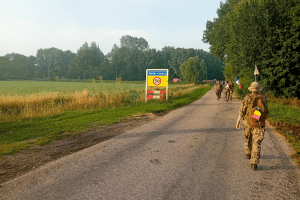
This is the most common approach among military participants from other countries. You walk in a group of between 11 and 40 members, one of whom serves as the team leader.
Especially during the first days, it is powerful to see the large German and Dutch groups pass by at an almost inhuman speed. When you also hear their marching songs, it almost brings tears to your eyes. Towards the end of the week, however, their pace slows down as they, too, feel the effects of the march.
The big advantage is obviously that as a participant, you can skip all the responsibility and just focus on keeping up. The team leader is responsible for keeping the time and ensuring that breaks do not drag on. But there are obviously major disadvantages to walking in a group, which is that at some stage, you will be forced to leave behind a participant who cannot keep up with the group’s pace. Unfortunately, it can be difficult to meet the time goal if even a single participant encounters problems. A decision must be made to save the group and get them to the finish line.
The groups start after the individual participants, and the start times are drawn by lottery, so in the worst case, you may have 1.5 hours less time than those who start first. You begin by walking in formation and saluting your contingent’s leadership. The group stays together and walks in formation throughout the march.
In 2018, we participated as a group and saw how problematic it can become if group members run into trouble. But it is clearly an experience to walk in a group, as the audience cheers a little extra when they see a larger formation. And you can utilize the team spirit to maintain a higher pace when needed and possible.
The group is also awarded a group medal if less than 10% of the group’s participants have dropped out. Participants, of course, receive their individual medals even if more than 10% drop out.