
General
This is a very important topic, but one that is incredibly neglected in the Finnish delegation. Much of this is due to the lack of follow-up, leaving training entirely up to the individual’s conscience. The other Nordic countries have much stricter requirements. For example, the Swedish delegation requires logged walking (e.g., with Strava) of about 300–400 km, as well as a marching test of 2×40 km, to participate.
Hopefully, the Finnish delegation will also start requiring training and marching tests eventually, so that we too can reduce the number of dropouts. The dropout rate for the Swedish and Danish delegations is around 2%; for us, it is almost 7%, and for the Yanks, over 10%.
However, it should also be remembered that training is highly individual, and to avoid injury, some may need to train more or less than others. But our goal is for everyone to have around 300 km of training before the summer of 2026. This should also include a couple of double sessions, meaning walking two days in a row to see how the body functions.
The purpose of training is not just to build up your physique, but also to test your equipment, taping, and train your mental toughness (“pannbenet”).
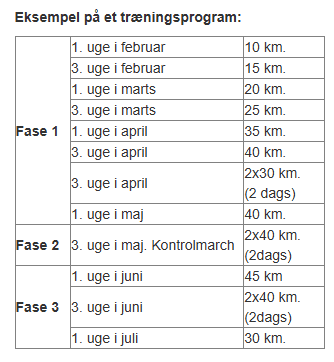
Above we have the Danes’ suggested training program, which is completely sensible for a first-time participant. If you follow the program, you will have about 500 km under your belt, which is more than enough.
Remember not to overtrain and break your body; there is no benefit in walking 1000 km, as I did before my first Nijmegen. The risk of injury is too great. Another thing to consider is to reduce training in the two weeks before the march—simple walks are enough. Feel free to vary all walking with light running, cycling, or swimming, for example.
Train with the Equipment You Intend to Use
If you are going to march with weight, you must train with weight to accustom your body to that load. That means walking with about 13 kg on your back from day one. DO NOT CHEAT ON THIS. If you cheat, there is a high risk of developing back problems when you are in Holland. Use the backpack you intend to use, and this also applies to those who do not need to carry extra weight. Use the backpack you intend to use and fill the hydration bladder when you train.
If you have new boots, they must be broken in during training, and this should happen early in the training period. You can get severe chafing when breaking in boots, but after about 100 km, it usually calms down. However, this is not something you should do in early summer. Remember that you almost need boots that are at least two sizes larger than usual, as your feet swell terribly. Especially on the last day, the boots feel far too small.
Take the opportunity to test different socks and underwear to see what works for you; unfortunately, you can get rather strange advice if you ask around. The only thing that works is to test for yourself and see, instead of ruining half a year’s training by relying on someone else.
Walk with someone else to help pass the time. Marching training is very boring and cannot be compared to running training, as the time commitment is significantly longer when walking. Especially during the longer training stages, company is invaluable.
Bear in mind that the heat is a greater problem in the Netherlands than here in the north; this affects both equipment and how your body reacts. Note where your bag chafes and consider what you can do about it, because if it irritates you here in early spring, it will definitely cause problems in 30–35 degree heat.
Marching Test
To keep track of what you are capable of, you should do a marching test in the spring or very early summer. MPK organizes a couple of suitable marches, such as the Kesäyön Marssi.
But you can certainly organize your own march if you want; the main thing is that you get to test your equipment and have the opportunity to fine-tune things. Remember that you don’t make major changes in June and July, so don’t get the brilliant idea of buying new boots at Midsummer. At this stage, you just have to accept the situation and work with what you have.
If you feel ready to go abroad, there are also longer marches organized outside Finland, and I believe we should be allowed to participate in the Swedes’ marching test if we wish.